
I remember the exact moment I realized I wasn’t “young” anymore. It wasn’t a birthday or a gray hair. It was a Saturday morning, and I was trying to move a heavy oak dresser up a flight of stairs—something I’d done dozens of times in my 20s without a second thought. Halfway up, my legs turned to jelly. My grip slipped. I wasn’t just tired; I felt fundamentally weaker. I was 34 at the time, and it hit me like a ton of bricks: the body I’d taken for granted was starting to exit the building. If you’ve felt that sudden “softening” or noticed your favorite jeans fitting differently despite your diet staying the same, you’re likely asking the same question I did: Why do we lose muscle after 30? It turns out, there’s a biological clock ticking under your skin, but the good news is you can actually slow it down—if you know which buttons to push.
What You’ll Learn
- The biological “glitch” that starts draining your strength the moment you hit 30.
- Why your hormones are staging a quiet rebellion (and how to negotiate with them).
- The sneaky role of “Anabolic Resistance” and why your protein shakes might be failing you.
- A 3-step blueprint to reclaim your muscle mass without living in the gym.
Invisible Leak: Sarcopenia Explained
Let’s call it what it is: Sarcopenia. It sounds like a rare tropical disease, but it’s actually just the Greek way of saying “poverty of flesh.” It’s the age-related loss of muscle mass and function. Most experts, including those from the Mayo Clinic, suggest that after the age of 30, you begin to lose as much as 3% to 5% of your muscle mass per decade.
Think of your muscle mass like a savings account. In your teens and 20s, the interest rates are sky-high. You can eat pizza, skip the gym for a week, and still look “tight.” But once you hit 30, the bank starts charging a monthly maintenance fee. If you aren’t actively depositing new “muscle capital,” your balance starts to dwindle.
I saw this happen with a buddy of mine, Mark. Mark was a college athlete who transitioned into a high-stress tech job. He didn’t get “fat” in the traditional sense, but by 38, he looked “smaller.” His shoulders narrowed, his posture slumped, and he complained of back pain constantly. He hadn’t changed his weight much, but he had swapped 10 pounds of functional muscle for 10 pounds of marbleized fat. That’s the danger of wondering why do we lose muscle—it’s often invisible until it’s a problem.
“Muscle mass is the primary predictor of longevity. It’s not just about looking good in a t-shirt; it’s about metabolic health, bone density, and your ability to survive a fall later in life.” — Dr. Peter Attia, Longevity Expert
Hormonal Slowdown: The Chemical Engine is Idling
One of the biggest reasons why we lose muscle after 30 is that our internal chemistry set starts to change. In our 20s, our bodies are flooded with growth hormone and testosterone (yes, women have it too, and they need it!). These hormones are like the construction foremen on a job site—they tell the body to take the protein you eat and build it into muscle fiber.
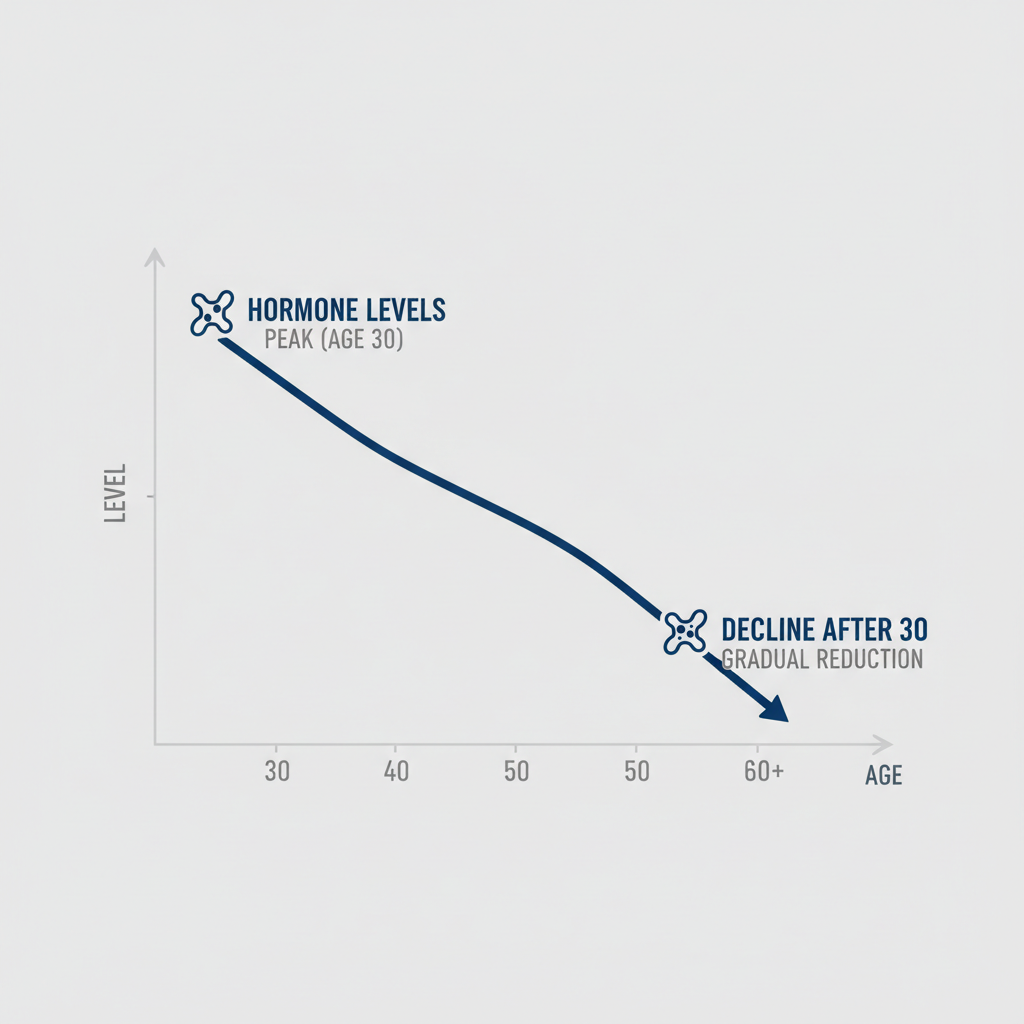
Then 30 hits. For men, testosterone levels typically drop by about 1% every year after 30. For women, the shifts in estrogen and progesterone during the transition toward perimenopause can be even more dramatic. When these “foremen” go on strike, your body becomes much less efficient at repairing the micro-tears created during exercise.
I remember sitting in my doctor’s office after complaining about feeling sluggish. He looked at my bloodwork and said, “Your levels are ‘normal’ for your age, but they’re not ‘optimal’ for performance.” That was an eye-opener. We start accepting “slow” as the default setting for aging, but it doesn’t have to be that way.
Anabolic Resistance: When Your Muscles Stop Listening
This is the part most people miss. Have you ever noticed that you can eat the same amount of protein as a 20-year-old, but you don’t seem to see the same results? That’s Anabolic Resistance.
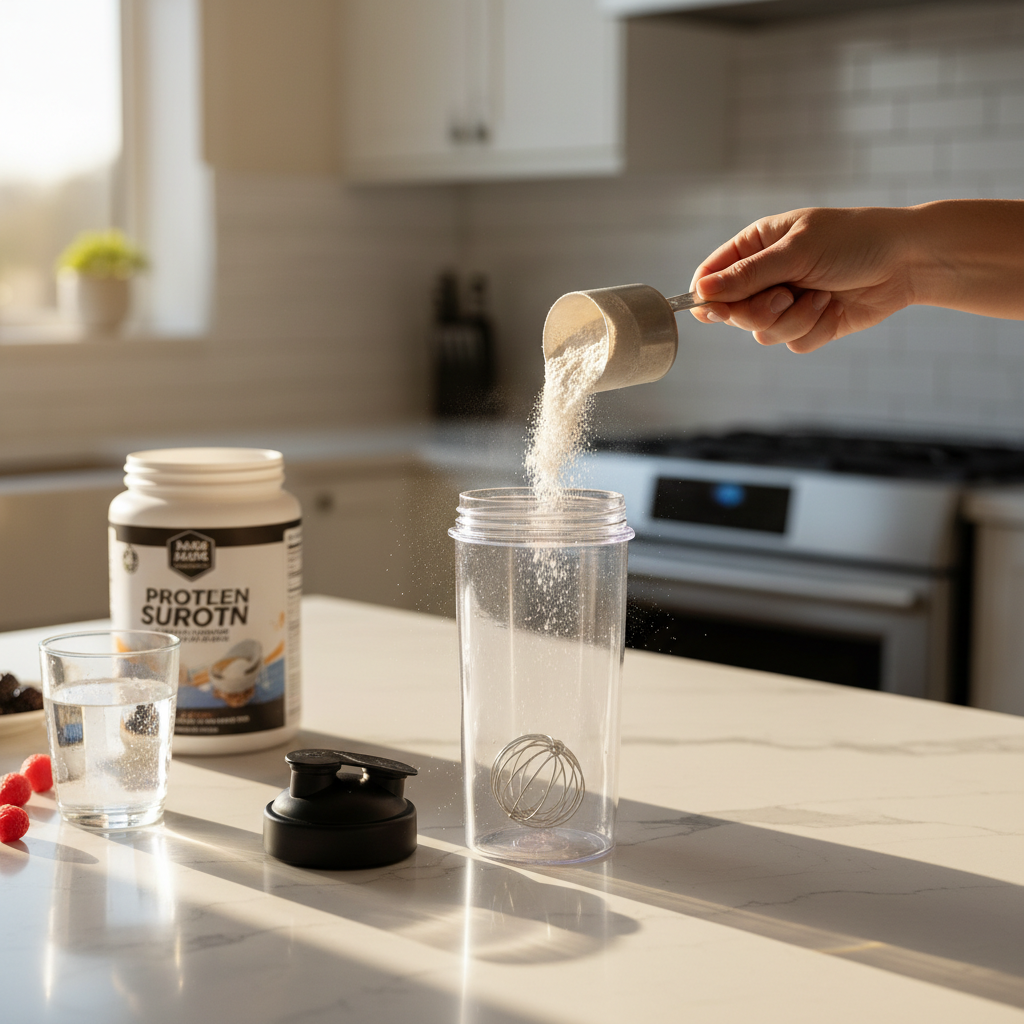
Essentially, as we age, our muscles become “deaf” to the signals of protein and exercise. In your 20s, a 20g protein shake is like a megaphone telling your muscles to grow. After 30 or 40, that same 20g shake is more like a whisper. This is often why do we lose muscle even when we think we’re “doing the right things.” Your body needs a higher “threshold” of stimulus just to maintain what it already has.
I tested this on myself. Following the standard advice of 0.8 grams of protein per kilogram of body weight left me feeling soft and weak. It wasn’t until I bumped that up significantly—closer to 1 gram per pound of goal body weight—that the needle moved. I had to “shout” at my muscles to get them to listen.
The “Sedentary Trap” and Mitochondrial Decay
Let’s be real for a second. Life gets in the way. At 22, your biggest stressor was a final exam. At 35, you’ve got a mortgage, a career, maybe kids, and a back that hurts if you sleep “wrong.” We move less. We sit in chairs for 8 hours a day staring at glowing rectangles.
Muscles are metabolically expensive. Your body doesn’t want to keep them if it doesn’t have to. If you don’t use them, your body essentially says, “Well, we don’t need these biceps for typing emails, let’s break them down for energy.”
Deep inside your muscle cells are mitochondria—the power plants. Research shows that as we age and become less active, these power plants become less efficient. They produce less energy and more “smoke” (oxidative stress). This creates a vicious cycle: you feel tired, so you move less; you move less, so you lose muscle; you lose muscle, so you feel even more tired. Breaking this cycle is the only way to answer the riddle of why do we lose muscle after 30 with a solution rather than a shrug.
How I Fought Back: The Three-Pillar Protocol
When I realized I was sliding down the sarcopenia slope, I didn’t just join a gym and start doing random bicep curls. I looked at the data. I looked at what actually works for people in their 30s, 40s, and 50s. Here is what I changed:
1. Progressive Overload (No More “Pink Dumbbells”)
You can’t just “tone.” Toning isn’t a physiological process. You either build muscle or you don’t. I had to start lifting heavy things. Not “Olympian” heavy, but heavy enough that the last two reps of a set were a struggle. I focused on the “big rocks”: squats, deadlifts, presses, and rows. These movements recruit the most muscle fibers and trigger the biggest hormonal response.
2. The Leucine Threshold
I learned about Leucine—an amino acid that acts as the “light switch” for muscle protein synthesis. You need about 2.5 to 3 grams of Leucine per meal to actually trigger muscle growth once you’re over 30. This means a tiny yogurt or a handful of almonds isn’t going to cut it. I started prioritizing high-quality animal proteins or fortified plant sources at every single meal.
3. Sleep as a Performance Drug
This was my biggest failure. I used to prize “the grind” and sleep 5 hours a night. Then I read a study showing that even one night of poor sleep can increase muscle breakdown and tank your testosterone. I turned my bedroom into a cave—blackout curtains, 68 degrees, no phone. My recovery skyrocketed.
What To Do Next
- Eat 30-40g of protein at breakfast: Most people back-load protein at dinner. Flip it. Give your body the building blocks early.
- Lift weights 3 times a week: Focus on compound movements. If you’re new, hire a coach for two sessions to learn form. It’s worth every penny.
- Track your progress: If you’re lifting the same weights today as you were three months ago, you aren’t building muscle. Add 2.5 lbs. Keep the body guessing.
- Prioritize Vitamin D and Omega-3s: These are proven to help with muscle protein synthesis and inflammation.
- Get 7+ hours of sleep: Your muscles don’t grow in the gym; they grow while you’re dreaming.
Questions People Actually Ask
Can I regain muscle after 50 if I’ve never lifted?
Absolutely. Research from the Journal of the American Medical Association shows that even 90-year-olds can increase muscle size and strength through resistance training. Your “ceiling” might be lower than a 20-year-old’s, but the floor is still very high. It’s never too late to start.
Is cardio making me lose muscle?
Excessive “steady-state” cardio (like running hours on a treadmill) can be catabolic if you aren’t eating enough. However, moderate cardio is great for heart health. The key is to make strength training the “main course” and cardio the “side dish.”
Do I need supplements to stop muscle loss?
Not necessarily, but Creatine Monohydrate is one of the most researched and safe supplements available. It helps with cellular energy and has been shown to be particularly effective for preserving muscle mass as we age. Always check with your doctor first.
Article Excerpt
Ever wonder why your strength seems to vanish once you hit your 30s? It’s not just “getting old”—it’s a biological process called Sarcopenia. Between hormonal shifts and a phenomenon called Anabolic Resistance, your body starts working against your muscles. But it’s not a death sentence. By shifting your diet toward higher protein, prioritizing heavy lifting, and respecting your recovery, you can actually reverse the trend. Muscle is your longevity insurance; here is how to keep your policy active.
Related Topics to Explore
- How to Calculate Your Ideal Protein Intake for Longevity
- 5 Best Compound Exercises for Beginners Over 30
- The Truth About Testosterone Boosters: Do They Actually Work?
- Vitamins and Minerals That Support Muscle Growth Naturally
Strength is a Choice, Not Just a Young Man’s Game
Looking back at that dresser I struggled to move, I realize now it was a wake-up call. I could have just accepted that I was “getting older,” or I could change my approach. If you’re asking why do we lose muscle after 30, don’t let the answer discourage you. Let it empower you. Your body is incredibly adaptable, regardless of what the calendar says. You don’t lose muscle because you’re old; you often “get old” because you’re losing muscle. Pick up something heavy today. Your 80-year-old self will thank you.